
The New LISA Consortium
The LISA Consortium is a scientific collaboration working together to maximize the scientific return of LISA, in particular using the LISA data. The Consortium will support all aspects of the LISA mission throughout the mission lifecycle.
The LISA Consortium is committed to promoting the long-term growth and development of the LISA scientific community by providing a supportive and inclusive environment that offers training, mentoring, and opportunities for researchers at all stages of their careers, in particular, early career scientists. The Consortium will also engage with the wider scientific community to foster interest in and support applications of the LISA data.
LISA Consortium membership applications will begin in 2025 with individuals joining either as a core member or as a community member.
Community members
Community members will be informed and involved but do not have to commit to deliverables and will not join member groups or working groups.
Core members
Core members will commit to specific deliverables subject to regular contribution review and can opt in to author lists for Consortium papers. Core members will identify a primary working group and have the option to form member groups by institution, region, research team, etc.
More details about the LISA Consortium structure and membership can be found on slides shared by the LISA Consortium Constituent Council.
Join us on the path to gravitational-wave astronomy in space!
Registration for consortium membership is now open. All relevant information for consortium membership application can be found here:
https://directory.lisamission.org/register
Dear LISA Consortium members,
You will find useful information about the LISA Consortium in the LISA Consortium User Guide, including links to LISA Open Science, LISA collaborative tools, most common LISA Acronyms, LISA websites, consortium organisation, and key documents:
https://lisa.pages.in2p3.fr/consortium-userguide/
Community Highlights
NASA, Partners Advance LISA Prototype Hardware
(27.01.2026) Engineers and scientists at NASA’s Goddard Space Flight Center in Greenbelt, Maryland, completed tests this month on a second early version of a key element of the upcoming LISA (Laser Interferometer Space Antenna) mission.
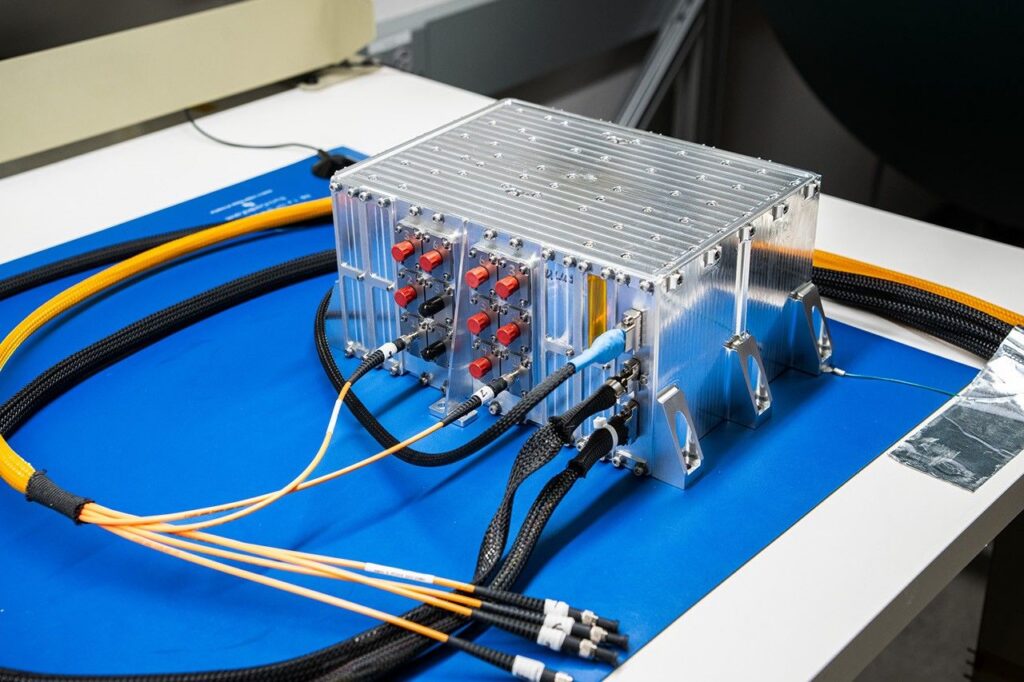
The LISA mission, a collaboration between ESA (the European Space Agency) and NASA, will use infrared lasers to detect gravitational waves, or ripples in the fabric of space-time. The tests involved the frequency reference system, delivered by BAE Systems, that will help control the lasers connecting LISA’s three spacecraft. The lasers must be finely tuned to make precise measurements — to within a trillionth of a meter, called a picometer.
Progress for LISA, the gravitational-wave observatory in space
(17.06.2025) AEI and OHB Systems AG have signed a contract for the further development and industrial production of LISA’s key measuring instrument.
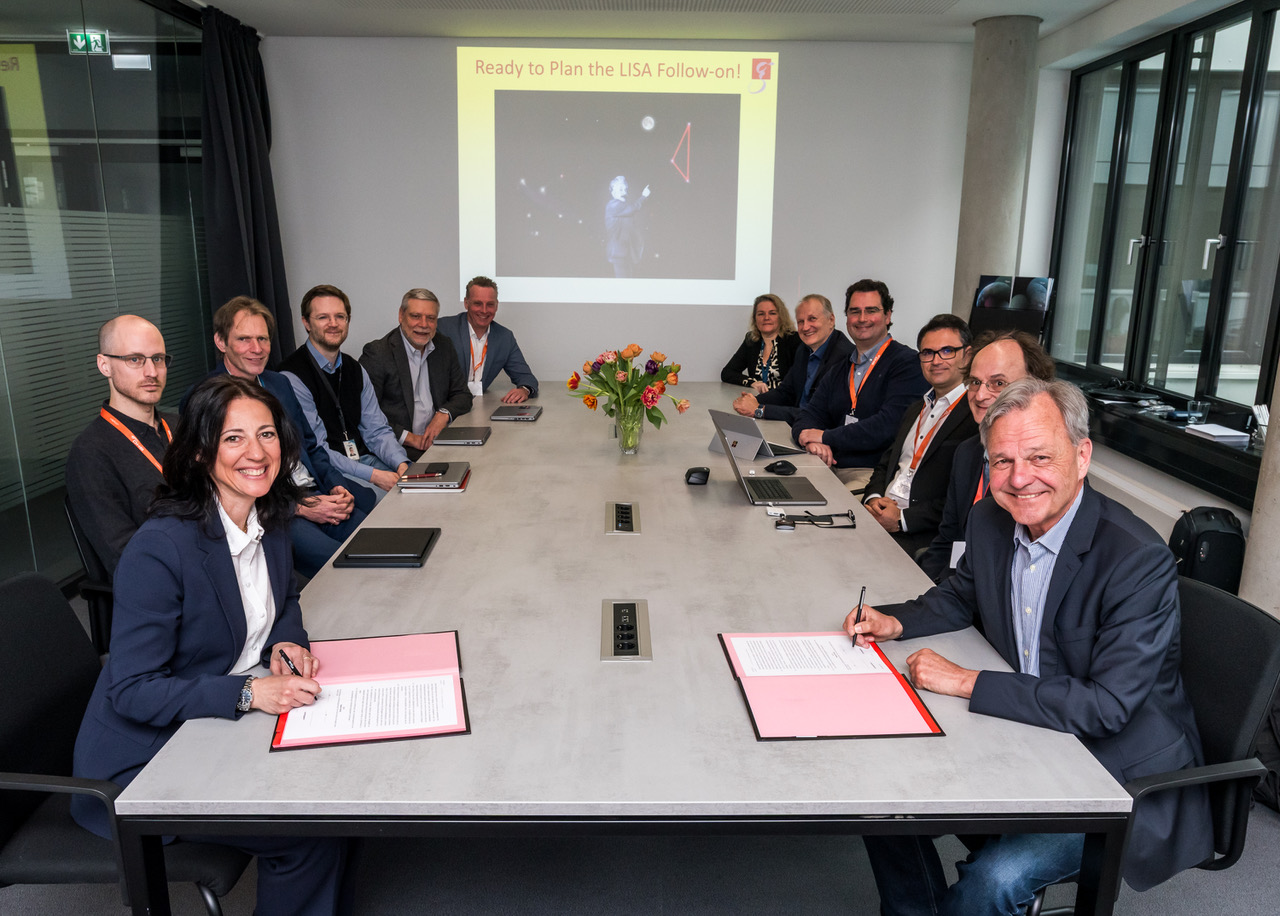
Chiara Pedersoli, CEO of OHB Systems AG, and Karsten Danzmann, director at the Max Planck Institute for Gravitational Physics (Albert Einstein Institute) in Hannover, sign the contract for the further development and industrial production of the LISA phasemeter. [© OHB ]
To the point:
- Progress for LISA: The gravitational-wave observatory is an ESA mission with the participation of NASA. It is scheduled for launch in 2035 and will gather entirely new information about the Universe.
- Key instrument: The phasemeter is the key instrument for LISA’s gravitational-wave observations. It was developed at the Max Planck Institute for Gravitational Physics
- Contract signed: The Max Planck Institute for Gravitational Physics and OHB Systems AG have signed a contract for the further development and production of the LISA phasemeter.